
Why real work always resists the models

Jack Dorsey has just said out loud what many Silicon Valley leaders think quietly. In From Hierarchy to Intelligence, the founder of Block describes his company of the future: an organization no longer coordinated by a hierarchy of managers, but by an artificial intelligence.
His starting point fits in a single sentence: hierarchies exist because humans are bad at handling information. From the Roman army to today’s multinationals, the same constraint keeps returning. A manager can only supervise a handful of people. As soon as an organization grows, you add a layer, then another, then another, until the pyramid is nothing more than a long chain of transmission.
For centuries, there was no alternative. Today, Dorsey argues, artificial intelligence changes the game. An AI that continuously aggregates the data produced across an entire company could offer a global, coherent, instant view of what is happening inside it. If the machine handles the circulation and synthesis of information, why keep all those layers of management?
The idea is seductive, and deeper than a simple headcount cut. Dorsey isn’t saying we will replace a few managers. He is saying the very structure of the company could be rebuilt around a central information system, far more capable than human hierarchies.
To this technological vision, another thinker of organizations offers almost the opposite. Frédéric Laloux, in Reinventing Organizations, studied companies that have largely dismantled the traditional hierarchy. Buurtzorg in the Netherlands and FAVI in France showed that you can coordinate thousands of people with far less central control than classical models assume. But where Dorsey sees technology as the answer to the coordination problem, Laloux bets first on the autonomy, trust, and responsibility of individuals.
Two bets on knowledge
Both start from the same observation. Large pyramids are slow, costly, often inefficient. The divergence lies elsewhere.
Dorsey believes technological progress finally makes it possible to centralize information efficiently:
- A “world model” of the company, continuously updated by AI. Intelligence no longer lives in people and the pyramid, but in the system. The model embodies command and control, and runs operations, performance, and priorities.
- No more middle management: only three roles remain, individual contributors, problem owners, and coaches.
- Money as a compass. The one signal that tells the company where to go, because it is, in his view, the only thing people don’t lie about. Surveys lie, attention lies, but the wallet tells the truth.
Laloux, for his part, advocates:
- Self-management, a form of self-governance that is not the absence of structure. Autonomous teams whose decisions belong to those in contact with reality.
- Wholeness, coming to work whole rather than reduced to a professional mask. You no longer amputate your emotions and intuitions at the door, because that is exactly what gives human judgment its value.
- An evolutionary, organic purpose. A calling the organization listens to and follows, rather than budget targets set from above. Support functions shrink to the bare minimum (thirty people for seven thousand caregivers at Buurtzorg) and hold no decision power.
Behind this disagreement hides a more fundamental question: what really limits an organization? At first glance the answer seems obvious: its ability to collect and transmit information. It’s the tacit assumption behind nearly every management tool of the past century, from dashboards to ERPs, from KPIs to collaboration software, and now AI. Each generation believes it has drawn a better map of reality.
But underneath, what truly separates them is the place of the human.
What the models will never see
The psychiatrist Christophe Dejours spent much of his career on what he calls the gap between prescribed work and real work. Prescribed work is the procedures, the rules, the plans, the instructions. Real work is what people actually do to keep things running. And the two never coincide.
Take a workshop: operators routinely bend the procedure to absorb the breakdown nobody had anticipated. Same in a hospital, where a nurse breaks a protocol that has become absurd in this particular case. Everywhere, thousands of small betrayals of the rules keep the organization standing despite the imperfection of its models.
That is why the work-to-rule strike is such a formidable weapon. Applying the rules to the letter is enough to reveal how much everything rests, in reality, on the practical intelligence of those who do the work. Marshal von Moltke put it another way: no plan survives first contact with the enemy. The modern company could say the same of its procedures.
And this is where the question of AI becomes truly interesting. The real issue is not whether an AI can replace some managers, it will in many cases. It is whether real work can be fully represented. Can we build a model complete enough to capture everything that makes an organization run?
The history of management answers mostly no. Taylorism believed it could break work down into perfectly measurable gestures. Reporting believed it could capture activity in a few indicators. ERPs believed they could represent flows, KPIs performance. Today, some imagine AI will represent all of it at once. But at every step, reality overflows the model. These models aren’t inherently bad; they simplify, by construction.
Seen this way, Dorsey and Laloux are not so much adversaries as the spokesmen of two philosophies. The first bets that our ability to represent reality keeps improving, and that good enough models will make coordination largely centralizable. The second bets that an essential part of reality will always remain human, local, contextual, resistant to formalization, and that it is therefore better to move the decision closer to those who live the situations. One is optimistic about knowledge, the other is cautious.
The future will probably prove neither entirely right. AI will melt away part of the coordination costs that once justified so many hierarchical layers; many functions of synthesis, reporting, and transmission will disappear. But that doesn’t spell the end of human judgment. Because work isn’t only a problem of information. It is also a problem of interpretation, of trust, of responsibility, and of constant adaptation to the unexpected.
So AI does not herald the end of management. What it will do is make untenable the idea that work fits inside a dashboard.
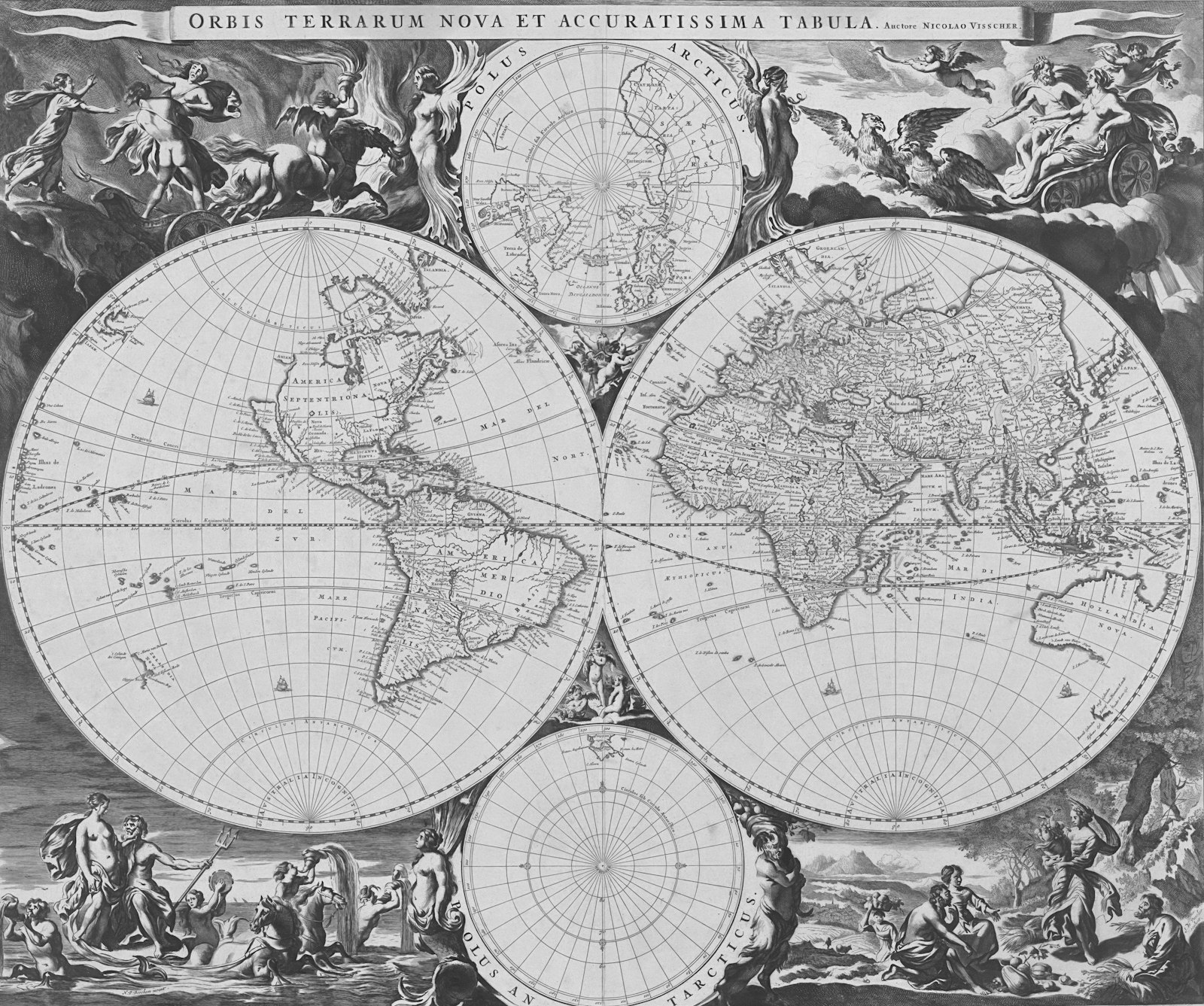
As for replacing human judgment, recall what Jorge Luis Borges described in his story “On Exactitude in Science”: the only way to have a perfect map is to build a map the size of the world it is trying to reproduce.
And that, in my view, is not about to happen any time soon.