
The dark mine

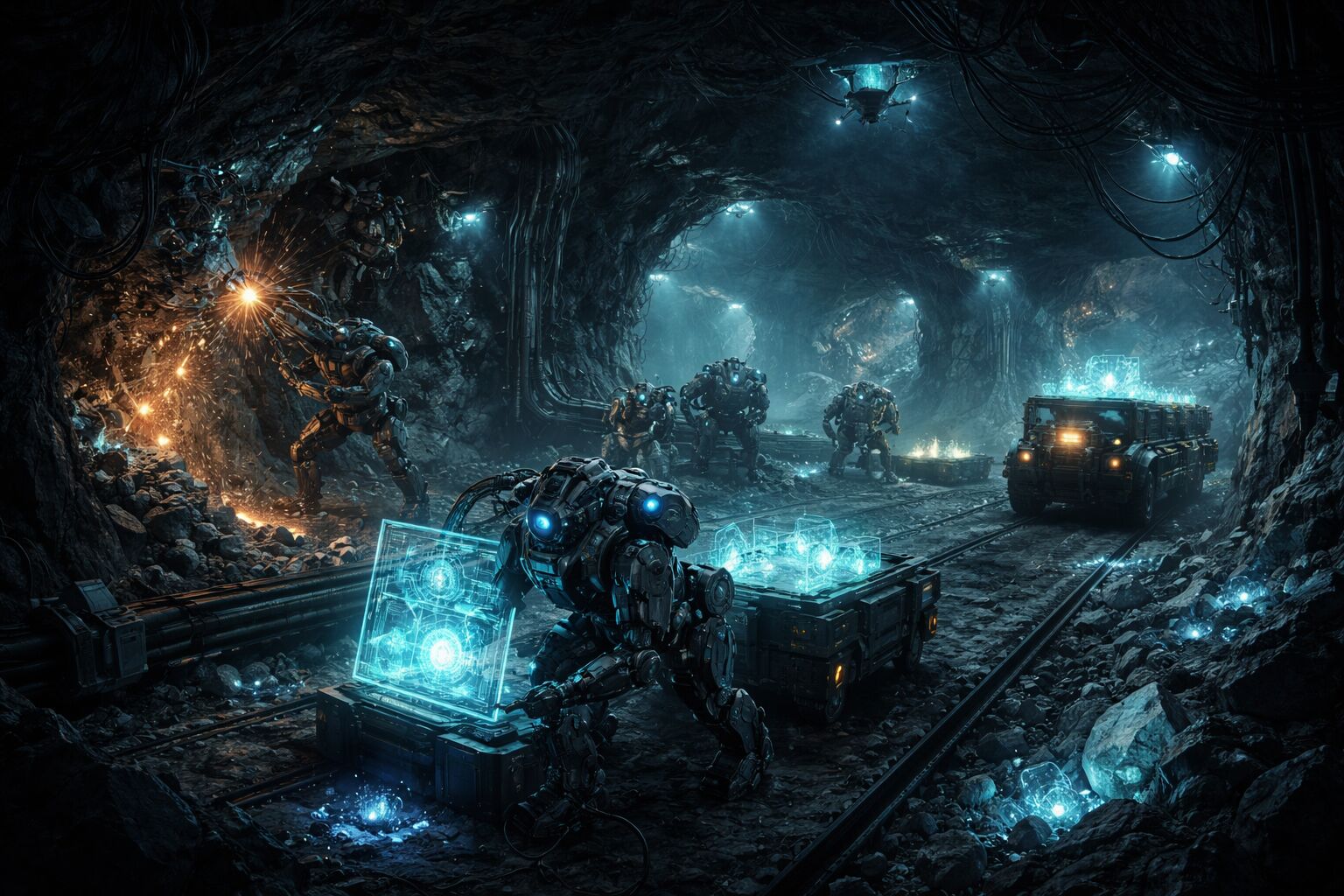
There’s a concept that’s been making the rounds in manufacturing for a few years now (and months on tech), the dark factory. A fully automated plant, lights off, no humans on the floor. Machines produce, assemble, and ship. The image is compelling, but it stays confined to what we already know how to make.
What interests me is what happens when you push that logic underground. Not a factory that executes, but a mine that explores. Autonomous agents that don’t answer your questions but formulate new ones. Unlike a real mine, where you know what ore looks like before you dig, a dark mine doesn’t know what it’s looking for until it finds it.
Factory versus mine
The difference is structural. In a dark factory, the process is bounded. You know what goes in, you know what comes out, and you optimize the path between the two. Code follows this logic well, with a ticket, a spec, and a deliverable. The agent replaces the developer on well-defined tasks, and the gain is measured in velocity.
In a mine, reality shows up uninvited. Blind spots can produce meaning. A vein can lead somewhere no one had mapped, drawing on the cognitive capabilities of LLMs and the sum of human knowledge they encode. A vein can also run dry, or hallucinate a continuity that doesn’t exist. But the marginal cost of each hypothesis tested is negligible compared to what it might reveal.
What I’m arguing here is straightforward. An organization that delegates question formulation to agents discovers structurally more than one that merely answers them. The bottleneck won’t be the mining, but the capacity to exploit the ore.
CRISP-DM as backbone
To ground this in operational reality, I needed not a shiny new framework but an old one that had been gathering dust in the back of everyone’s closet.
I went and dug up CRISP-DM. We confined it to predictive modeling for years, then forgot about it just as quickly. Yet the core process is simple. Understand the business need, understand the data, connect the two, and above all iterate relentlessly. It’s also an informal framework, a guideline that gives teams the autonomy to improvise when the terrain demands it. Originally a collaboration standard between research labs, it was often criticized for being too rigid. But that rigidity is precisely what agents need to stay reasonably deterministic. What was a flaw for humans strikes me as a feature for machines.
That’s the principle I’m applying, combined with NIST data exploration patterns as a foundation, orchestrated through agent swarms. The roles differ from what you see in software development. Leads, Scouts, Explorers, Synthesizers, and Challengers are all coordinated through structured signals, convergence metrics, and satisfaction scores. The implementation details will be a separate post.
Testing ground
To test this logic on the ground, the example I’m iterating on is rather high-level but simple enough. Take Spotify. Their initial North Star KPI was subscriber count. Then they asked a different question: how do users actually behave when they genuinely value the service? Is the subscription really what captures value, or is it something else? They ended up switching to minutes listened, because that’s where the generated value actually lived. It took them years to ask themselves the right question. I think a dark mine could surface that kind of reframing in days, because the cost of each hypothesis tested is negligible and agents carry no emotional investment in the previous answer.
That logic is my baseline in the Jolimoi context. Today, a Data Analyst answers questions a human has already formulated. The bias is structural, because you can only find what you’re looking for. A dark mine generates questions no one would have asked, and that’s fundamentally what interests me. Discovery emerges from the hypothesis no one had thought worth testing, or even imagined. We’re at the frontier of an artistic process … and that too will be the subject of a future post.
The real risk
Still, surfacing those hypotheses has a cost. The operational complexity is real, with six phases, six agent types, structured signals, and feedback loops between roles. But it’s complexity in service of exploration, not of protection.
And that’s where the real question surfaces. Just as a dark factory dedicated to software production can overwhelm the organization it sits on, a dark mine creates a symmetric problem. How does a structure build the conditions to act on what the mine surfaces?
The risk isn’t that the mine finds nothing, but that it finds everything, and the organization drowns in ore it can’t refine.