
The Engagement Crisis and the Search for Meaning: From Stoicism to Robotism

We are what we share. But here arises the question of the meaning of action, of sharing. What to do with those who don’t want to, cannot, or don’t wish to share? In an era where we’ll seek to maximize network effects, which inextricably feed collective intelligence, it’s worth examining those people who don’t fit into this framework, or at least, who don’t try to participate in the general conversation.
When implementing a digital transformation project, we’ll therefore look for “early adopters.” Good souls, capable of championing the project among their colleagues and priming the information pump. These individuals will have the privilege of being able to combine corporate engagement with required qualities (this is often when people will mistakenly talk to us about digital natives).
The Dehumanization of Work
The idea would be to create vocations. No sense of obligation, obviously, because serendipity will only occur under this single condition: that of everyone’s goodwill. So how do we create this emulsion? Here, I can only alert you to the parallels between the following elements:
- Digital engagement: see the 1% rule
- Employee engagement: only 13% are engaged
- Political engagement: approximately 750,000 members of various parties for 600,000 elected officials
- Union engagement: 7% of the workforce, or 1.7 million
A very simple conclusion. Personally, I find it quite evident.
Because sharing is only motivated in certain places:
- Providing interesting and entertaining content
- Defining oneself to others (reinforcing one’s image, passions…)
- Growing and nurturing one’s network (staying connected with others, discovering people who share the same passions…)
- Flourishing (receiving comments on one’s publications, feeling involved…)
- Supporting causes and opinions that matter to us
But what is engagement, if not the counterpart to participation? We cannot reduce the voluntary servitude that employees demonstrate toward their company to the simple equation work = salary. We have reached a point in our history where our organizations, by perpetuating methods from the industrial era, dehumanize work to a rarely reached degree.
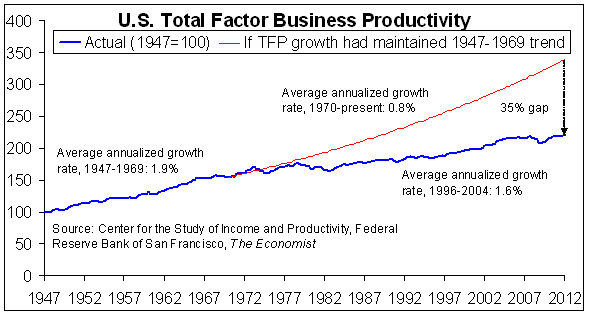
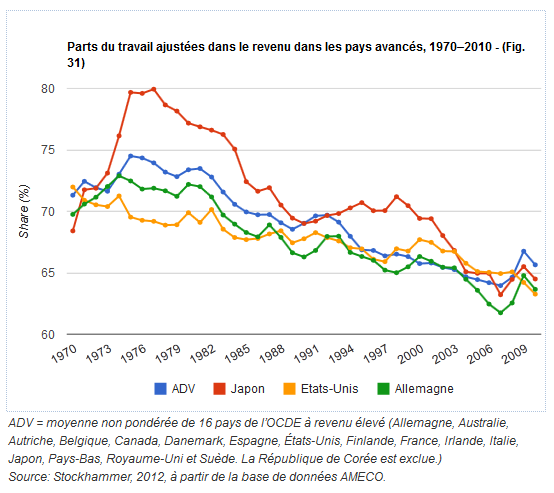
By seeking to go ever further, to always want to grow, we find ourselves in an era of temporal scarcity. Since growth is not, far from it (see diagram opposite), tied to productivity gains, we had to do ever more. Information becomes ever-increasing, technology omniscient, but nothing helps. Paradox ?
“You can see the computer age everywhere but in the productivity statistics” — Robert Solow, Nobel Prize in Economics
As a result, we live today in permanent urgency! The cause? Our available time is simply not expandable. We have become ever more efficient and productive, but simply at our own expense, forced as we were to produce ever more. Our personal and professional lives gradually merge, for better, but perhaps above all for worse.
Because make no mistake, disengagement is a self-protection system. Now, most employees practice ataraxia, referring to the Stoic doctrine and the following maxim:
Bear and forbear
— Epictetus
Since action on what we cannot control is futile and disengagement is becoming massive, certain supposedly motivating palliatives are implemented. That competitions and rewards are commonplace in many companies will surprise no one, with the perverse effects we know…
From then on, sharing becomes utopian.
An Appearance of a Solution?
Solving the equation of what I’ll call the stoics is therefore paramount, especially since new generations advocate a life ideal that promotes work-life balance.
At the same time, companies see competition intensifying. To remedy this, innovation and digital have become the watchwords, and only four strategic alternatives are offered to them:
- Be agile and innovative while staying small. The company’s impact on the world remains limited and remains under threat from third-party competition
- Grow without establishing rules and suffer from chaos. Which could mean dying a slow death…
- Grow and pilot the efficiency of one’s business model through managerial logic (management + quality). Here, we bet that the market on which the company positions itself cannot evolve or be disrupted through the emergence of a breakthrough, a new competitor
- Grow while avoiding chaos…
…by **recruiting highly adapted personnel **instead of betting on processes/qualifications, but relying on self-discipline and a “startup” spirit (relaxation + agility). This is typically what most companies from the digital world (Google and the like) adopt as a method. For this, they practice recruitment that is:
- Elitist: only recruiting highly educated individuals (cream of the crop), allowing for good selection bases
- Restrictive: filtering out those who don’t have the right wiring (passing them through the sieve of company culture) and who don’t excel in their field
- Attractive: paying them top dollar, treating them well (“fan service,” free cafeteria, remote work possibilities, etc.)
- Pragmatic: recruiting those who know how to do, are part of the “active” fringe of the target population (and fall into the percentages cited above), who have a real entrepreneurial spirit (which will be put to the service of the organization) and craftsmanship (having expertise beyond the purely technical context)
- Active: going to find the ideal candidate, wherever they are on the globe
Unfortunately, we observe that most companies apply exactly the opposite formula, acting with extreme passivity. Today we still look for skills (human “resources”) in extremely limited employment pools, which are in line with a company keeping its head down (teamwork, stress management, adaptability, etc.).
Of course, you’ll tell me it’s easier to attract the best by being called Google, and you’d be right. But between these two extremes, there exists a middle ground where every company should be able to position itself. If the magic recipe were to recruit better, it is therefore especially favorable to companies that want to, must, can, and have the means to recruit the best.
But the question of the stoics still remains, those very people who indirectly don’t fit the mold of the sought-after “model” employees. The answer provided by the web giants may seem simple: not integrating them into their recruitment equation. Which is obviously not the case for the vast majority of companies, which often overhire personnel in order to fill the gaps of an organization undermined by disengagement.
Since the vast majority of companies don’t have the luxury of being startups and resetting the counters, there remains a significant problem. Are they really factories for generating despair, useless positions as they grow? Note that as a general rule, the more employees a company has, the less productive each of its employees is: when you add 10% of employees, you lose 1% of productivity per employee.
At the end of the tunnel, they’ll only have one alternative left: why not simply eliminate these “useless” people? We may be far from imagining the truth…
Here Come the Robots
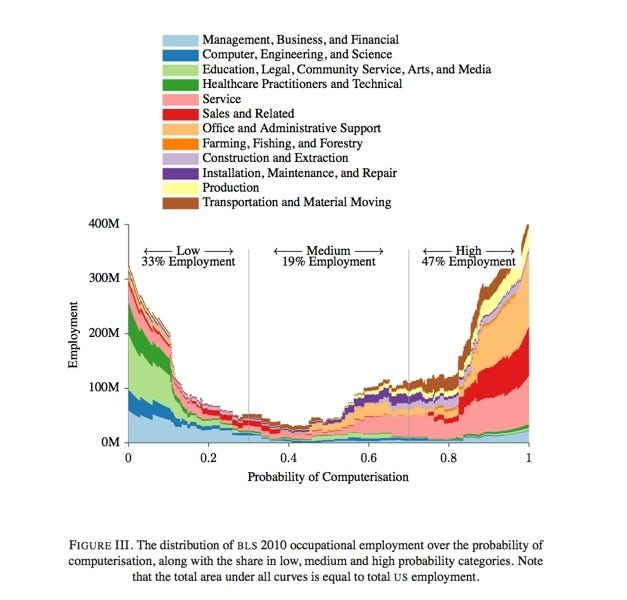
A rather dark path is the very future of work, or at least of certain types of jobs. This is the subject of Brynjolfsson and McAfee’s book, Race Against the Machine. In the long term, 47% of jobs should be entrusted to robots.
This paradigm shift is no longer just for the benefit of manual jobs. Certain domains, such as services, sales, administration, or transportation, risk to varying degrees a wave of automation.
So here we are, facing a terrible equation. Robotization would therefore be the ultimate stage of productivity, but more important is the strong correlation between unemployment and profits. The more the first increases, the more the second explodes.
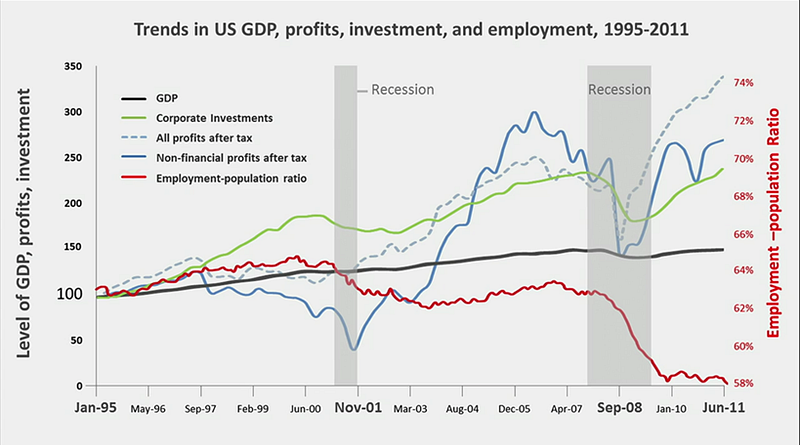
Our world therefore favors capital. Moreover, value creation is now completely disrupted and the prospects brought by robotics may even accentuate the trend. In the end, labor’s share of generated income will no doubt continue to decline inexorably.
But our salvation might well be found right here. We are, I think, currently in the middle of a transformation of our civilization: that of the passage from the industrial era to the information era.
Even before being able to imagine and think about how to transform our organizations, we had to make do with what we had: namely, adapt with what we had learned during the industrial era. A conception of work that becomes dehumanized, as we might do with a robot…
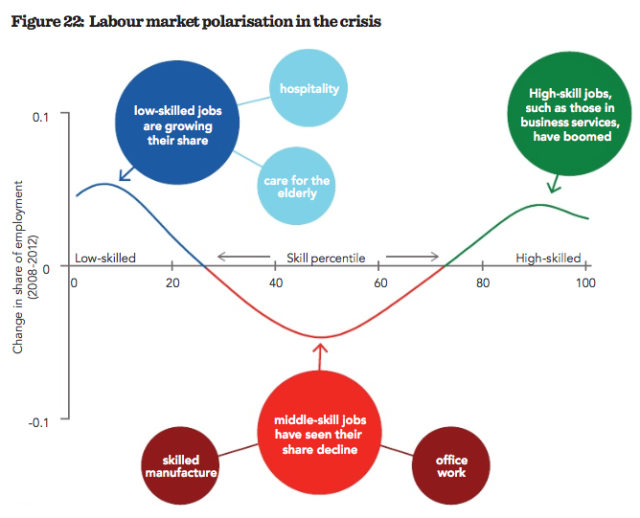
As a result, we are trying to automate humanly what we should ultimately automate, primarily through robotics. Because if we believe the projections, we should abstract away support jobs, and perhaps bureaucracy. Indirectly, it’s an entire part of support jobs that will disappear, favoring the great divide between high and low-skilled jobs.
But from my point of view, the solution lies in the meaning of work as well as a new social contract between organizations and employees. The freedoms of unbridled capitalism push us too much toward egocentrism and make us forget our duties and our human nature.
This is the observation of Toyota, the champions of human productivity, who by over-robotizing their activities and minimizing human elements to the maximum, ultimately became less efficient. Their observations are the same as those of the web giants: employ people who can work with and for machines. Craftspeople, intrapreneurs.
Robotics may perhaps annihilate the support trades of companies. Robotics may perhaps annihilate the middle classes, widening the gaps between rich and poor. But too many companies will follow the movement and remain mired in a crisis of meaning.
Brutal Velocity
So what about the present moment? For a company where disengagement reigns, three options exist:
- Transform. Here, it’s not about half-measures carried by a few rare people, but a long and radical transformation of the company. Here, it’s not the question of the organization’s profitability, but rather its survival
- Act with resilience. Go find growth wherever you can. Either through merger/acquisition or various layoff plans, or by seeking new gimmicks aimed at increasing the productivity of the organization and its employees (despite human impacts)
- Die. Following the previous point, when it goes badly (this can last a very long time depending on the size of the company/revenue). A pessimistic observation, but I invite you to look at recent news to see that the movement is already underway (see following graph)
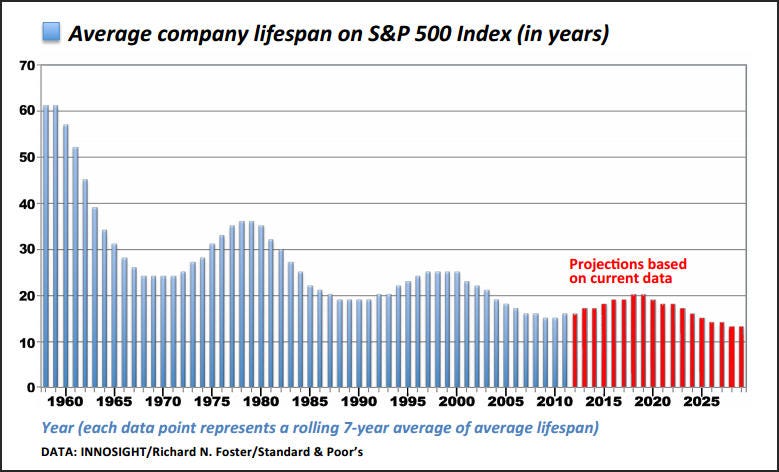
In any case, the “human cost” doesn’t seem to be spared. The stoics will moreover be the first affected, due to dehumanization, to the robotization of our society and work.
More and more companies and jobs will indirectly continue to disappear. The only exit condition will remain the imperative of economic survival, because make no mistake, human history is full of these ugly moments where the interests of a few have always prevailed over the masses. Except that in this game, some will surely play at burning their wings, and I hope, will change mentalities.
“Institutions will do everything to preserve the problem of which they are the solution”
“I often hear people say they’re too busy to spend time on improvement. I tell them they’ll stop being busy when they’re dead or their company has gone bankrupt”
“It is not necessary to change. Survival is not mandatory”
To go beyond such predictions, companies will have to solve once and for all the problem of ever more massive disengagement and reintroduce meaning to work. And, to finish on a slightly optimistic note, I don’t believe we’ll all be forced to stay home tomorrow. Generalized unemployment probably won’t happen, new jobs and markets will emerge, and it’s a safe bet that humanity will adapt to this new era, which we’ll just hope is a little more harmonious than the previous ones.